خلاصه
Background:
Krabbe disease is a rare autosomal recessive leukodystrophy, typically considered a fatal disorder of infancy. Adult-onset forms are uncommon and diagnostically challenging due to their nonspecific presentations.
Case presentation:
We report a consanguineous Han Chinese pedigree comprising two siblings diagnosed with adult-onset Krabbe disease, both carrying the identical homozygous GALC c.1048T>G (p.Phe350Val) mutation. Notably, the age at onset differed by 26 years between the two siblings (49 years vs. 23 years), with markedly distinct clinical trajectories—one presenting with progressive dysarthria and peripheral neuropathy, and the other with spastic paraplegia, ultimately leading to wheelchair dependence.
Conclusion:
This report describes a family in which identical homozygous GALC mutations presented with markedly distinct clinical phenotypes and disease trajectories during adulthood, thereby substantially expanding the current understanding of the phenotypic spectrum of Krabbe disease and offering novel insights into the differential diagnosis of adult-onset neurodegenerative disorders.
1 Introduction
Krabbe disease has traditionally been regarded as a fatal leukodystrophy predominantly affecting infants. However, late-onset forms (onset >2 years of age), particularly adult-onset cases (onset >18 years), are frequently underdiagnosed or misdiagnosed as multiple sclerosis, hereditary spastic paraplegia, or chronic inflammatory demyelinating polyneuropathy due to their rarity and nonspecific clinical manifestations. The GALC gene exhibits a broad mutation spectrum, and certain mutations (e.g., c.1048T>G) are associated with residual enzyme activity that may lead to very-late-onset phenotypes. Nevertheless, the mechanisms underlying the wide inter-individual variability in age at onset—spanning several decades—within the same family pedigree remain unclear. This report describes a family in which identical homozygous GALC mutations presented with markedly distinct clinical phenotypes and disease trajectories during adulthood, thereby substantially expanding the current understanding of the phenotypic spectrum of Krabbe disease and offering novel insights into the differential. The clinical timeline for both patients is summarized in Table 1.
| Time point | Patient II-2 (proband, sister) | Patient II-3 (brother) |
|---|---|---|
| Age at onset | 49 years | 23 years |
| Initial symptoms | Progressive dysarthria | Progressive limb weakness, difficulty walking |
| Age at first evaluation | 50 years | 35 years |
| Neurophysiology | Demyelinating peripheral neuropathy | Demyelinating peripheral neuropathy (first detected at age 33) |
| Brain MRI | Normal | Few small ischemic foci |
| Genetic diagnosis | Homozygous GALC c.1048T>G (p.Phe350Val) | Homozygous GALC c.1048T>G (p.Phe350Val) |
| Age at genetic confirmation | 50سال | 35سال |
| Age at last follow-up | 52سال | 37سال |
| Functional status at last follow-up | Dysarthria (speech understandable), ambulatory, normal daily living | Wheelchair-dependent |
Timeline of clinical course for patients II-2 and II-3.
2 Case report
2.1 Pedigree members
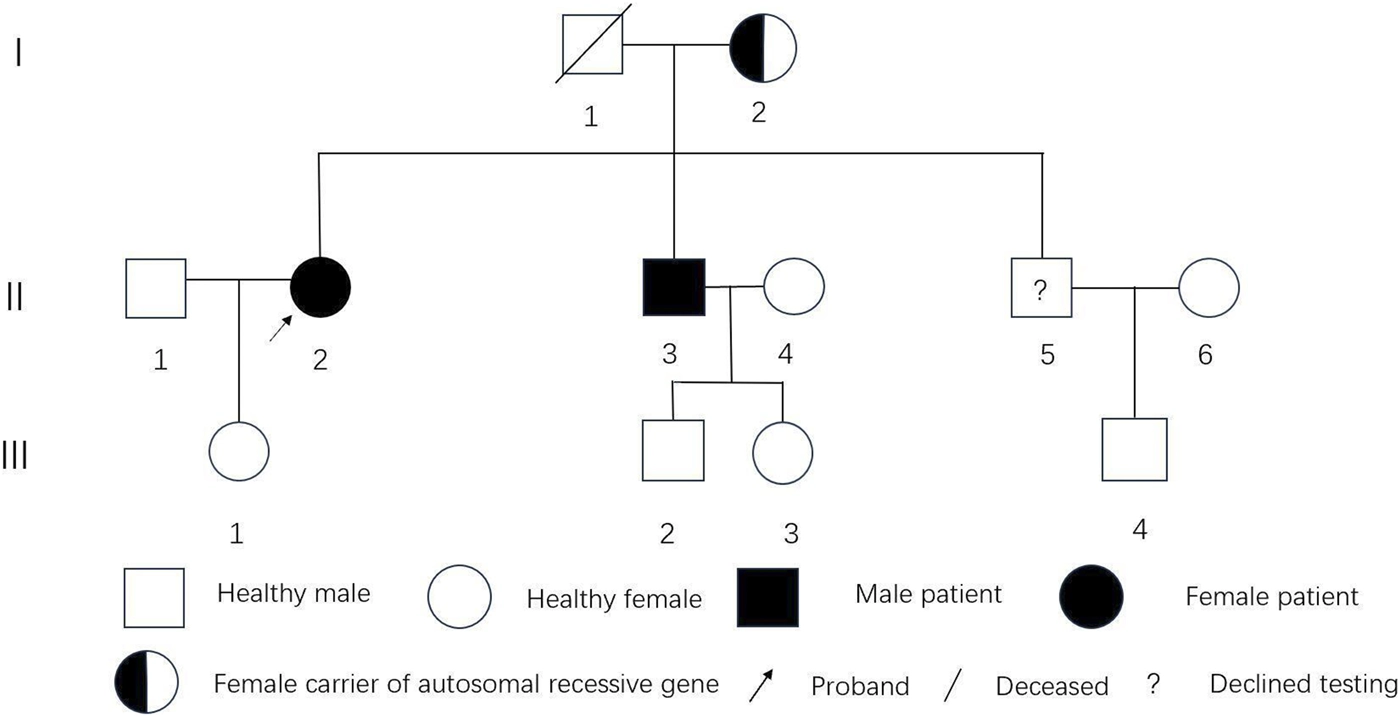
The family members are of Han Chinese ethnicity with a history of consanguineous marriage. The parents (I-1, I-2) are phenotypically normal and had one daughter (II-2, the proband) and two sons (II-3 and II-5) (Figure 1).
2.2 Proband (II-2, onset at age 49)
The proband is a female who was admitted to the hospital with a chief complaint of progressive dysarthria for 1 year. The patient began experiencing dysarthria 1 year prior to admission, which has progressively worsened.Past medical history: The patient underwent surgery for papillary thyroid carcinoma 10 years ago and has been regularly taking oral levothyroxine sodium since the operation.Neurological examination: The patient was alert and oriented. Mild dysarthria and tongue muscle atrophy were observed, while the remaining cranial nerve examinations were unremarkable. Atrophy of the fourth dorsal interosseous muscle of the left hand and the thenar muscles of the right hand was noted. The patient also presented with pes cavus deformity.Laboratory investigations: Routine blood, urine, and stool tests, liver and kidney function tests, blood glucose, lipid profile, folic acid, vitamin B12, serum homocysteine, thyroid function tests, autoantibody panel, rheumatologic and immunological screening, antinuclear antibodies (ANA), anti-neutrophil cytoplasmic antibodies (ANCA), tumor markers, tests for HIV, syphilis, hepatitis B and C, serum immunofixation electrophoresis, and serum antibodies associated with peripheral neuropathy were all within normal limits or negative. Galactocerebrosidase activity in leukocytes, measured using the artificial fluorogenic substrate method, was 348 nmol/L/h, corresponding to 33.72% of the normal control value.Cerebrospinal fluid (CSF) analysis: Lumbar puncture revealed an opening pressure of approximately 180 mmH2A. آنالیز روتین CSF، از جمله بیوشیمی و سیتولوژی، هیچ ناهنجاری را نشان نداد. بررسی نوروفیزیولوژیک: مطالعات هدایت عصبی نوروپاتی محیطی دمیلینه کننده را نشان می دهد. تصویربرداری عصبی: MRI مغز هیچ ناهنجاری را نشان نداد. MRI تقویتشده با کنتراست شبکه بازویی و لومبوساکرال هیچ ضخیم شدن یا افزایش غیرطبیعی قابل توجهی در ریشههای عصبی دو طرفه بازویی و لومبوساکرال نشان نداد.
2.3 Proband’s younger brother (II-3, onset at age 23)
The patient is a 35-year-old male who presented with a 12-year history of progressive limb weakness accompanied by stiffness and difficulty walking. His past medical history was unremarkable.Neurological examination revealed tongue fasciculations and atrophy. Decreased muscle bulk and atrophy were observed in both upper limbs, as well as atrophy of the bilateral quadriceps femoris muscles, more pronounced on the right side. Muscle strength testing revealed: left upper limb proximal 3/5, distal 2-/5; right upper limb proximal 3+/5, distal 2+/5; right lower limb 5-/5; left lower limb 5/5. Muscle tone was decreased in both upper limbs. Hypoesthesia to pinprick and reduced vibratory sensation were noted in the left upper limb below the elbow, predominantly in the ulnar distribution. Biceps and triceps reflexes were absent bilaterally, while bilateral patellar and Achilles tendon reflexes were hyperactive. Bilateral Chaddock and Babinski signs were positive.Neurophysiological examination performed 10 years after disease onset (at age 33) revealed demyelinating peripheral neuropathy.Laboratory investigations: Routine blood, urine, and stool tests, erythrocyte sedimentation rate (ESR), coagulation function tests, antinuclear antibodies (ANA), urinary light chains, immunofixation electrophoresis, folic acid, vitamin B12, vasculitis screening tests, rheumatoid arthritis panel, and immunoglobulins were all within normal limits or negative.Serum antibodies including Hu, Yo, Ri, GM1, VGKC, and anti-Borrelia antibodies were also negative. Galactocerebrosidase activity in leukocytes, measured using the artificial fluorogenic substrate method, was 72 nmol/L/h, corresponding to 6.98% of the normal control value.Cerebrospinal fluid (CSF) analysis: Lumbar puncture revealed an opening pressure of approximately 110 mmH2 A. آنالیز معمول CSF و سیتولوژی هیچ ناهنجاری را نشان نداد. بیوشیمی CSF سطح پروتئین کمی بالا 0.55 گرم در لیتر را نشان داد. تمام تست های CSF برای RPR، TORCH، Hu، Yo، Ri، GM1، VGKC و آنتی بادی های ضد بورلیال منفی بود. تصویربرداری عصبی: MRI مغز چندین کانون کوچک ایسکمیک را نشان داد. MRI دهانه رحم هیچ ناهنجاری را نشان نداد. سونوگرافی عصب هر دو اندام فوقانی ادم منتشر و ضخیم شدن شبکه دو طرفه بازویی، اعصاب میانی و اعصاب اولنار را نشان داد.
Neither patient received disease-specific therapy. At the 2-year follow-up, the proband (II-2, aged 52) remained ambulatory with dysarthria (speech understandable) and continued normal daily living without assistance. Her younger brother (II-3, aged 38) had become wheelchair-dependent due to progressive lower limb weakness.
2.4 Genetic analysis
After obtaining informed consent, 5 mL of peripheral blood was collected from II-2, II-3, and their mother for whole-exome sequencing (WES). Individual II-5 declined participation. All examinations were performed with the informed consent of the patients and approval from the Ethics Committee of Hengshui People’s Hospital.High-throughput sequencing and subsequent Sanger sequencing identified a mutation site: the c.1048T>G variant in the GALC gene. Sanger sequencing validation confirmed that both II-2 and II-3 carried a homozygous c.1048T>G (p.Phe350Val) mutation in the GALC gene (Figures 2، 3)، در حالی که مادر آنها ناقل هتروزیگوت جهش c.1048T>G (p.Phe350Val) است (Figure 4). شجره نامه در Figure 4.
3 Discussion
Krabbe disease is a rare autosomal recessive lysosomal storage disorder first reported by Knud Krabbe in 1916 (ژن عامل، ژن β-گالاکتوسربروزیداز (GALC) است که بر روی کروموزوم 14q24.3-q32.1 قرار دارد.). جهش در این ژن منجر به کاهش فعالیت آنزیم گالاکتوسربروزیداز می شود که منجر به آسیب به سیستم عصبی مرکزی و محیطی می شود.).
تظاهرات بالینی بیماری کرابه در بزرگسالی بسیار ناهمگن است و تشخیص همچنان یک چالش است. علائم ارائه شده ممکن است شامل پاراپلژی اسپاستیک، آتاکسی، نوروپاتی محیطی، اختلال بینایی و سایر علائم باشد که اغلب منجر به تشخیص اشتباه می شود.تصویربرداری رزونانس مغناطیسی جمجمه (MRI) با یافته های مشخصه ای از جمله افزایش شدت T2 در مناطقی مانند شکنج پیش مرکزی و پس مرکزی، مجاری قشر نخاعی، تشعشعات بینایی و لم های داخلی، نقش مهمی در تشخیص دارد. مطالعات الکترودیاگنوستیک معمولا نوروپاتی محیطی دمیلینه کننده منتشر را نشان می دهد که درگیری آکسون کمتر شایع است.; گونه GALC c.1048T>G (p.Phe350Val) طبق دستورالعمل های ACMG/AMP (PMID: 27993330) همراه با تجزیه و تحلیل جداسازی شجره طبقه بندی شد و بر اساس شواهد زیر به عنوان یک واریانت بیماریزای احتمالی بر اساس شواهد زیر تعیین شد: PM2 (فقدان PM2 در پایگاه های اطلاعاتی افراد دارای تاثیر PM) خانواده فامیلی)، PP1 (تفکیک همزمان با بیماری در شجره نامه) و PP3 (چند in silico ابزارها اثرات مضر را پیش بینی می کنند).
در این مطالعه، افراد مبتلا ناقل گونه c.1048T>G (p.Phe350Val) بودند که یک جهش نادرست در ناحیه کد کننده ژن GALC است. تجزیه و تحلیل داده های توالی یابی نسل بعدی (NGS) از شجره نامه نشان داد که مادر پروباند یک ناقل هتروزیگوت این گونه بود، در حالی که افراد II-2 و II-3 برای واریانت هموزیگوت بودند. این نوع در پایگاه داده بسامد جمعیت gnomAD در مقیاس بزرگ گزارش نشده است. با این حال، در بیماران متعدد بیماری کرابه، معمولاً در حالت هتروزیگوت مرکب، ثبت شده است. بر اساس تجزیه و تحلیل جداسازی در این شجره، واریانت به عنوان بیماریزا طبقه بندی شد.
این شجره دو فنوتیپ بالینی شدید و غیر معمول از بیماری کرابه با شروع بزرگسالان را ارائه می دهد: یک مورد به عنوان سندرم “پاراپلژی اسپاستیک- نوروپاتی محیطی” با شروع موذی و به آرامی پیشرونده (در سن 23 سالگی شروع می شود) و دیگری که با دیزآرتری و نوروپاتی محیطی مشخص می شود (49 سالگی). بیماری کرابه با شروع بزرگسالان «تقلید کننده فوقالعاده» است. در این شجره، فنوتیپ اسپاستیک پاراپلژی-نوروپاتی محیطی فرد II-3 میتواند به راحتی به عنوان اسکلروز جانبی آمیوتروفیک یا پاراپلژی اسپاستیک ارثی (HSP) تشخیص داده شود.مک کارون و همکاران. مردی 55 ساله با یک نوع بیماریزای جدید GALC را گزارش کرد که با پاراپارزی اسپاستیک پیشرونده آهسته با تاخیر تشخیصی بیش از 3 سال مراجعه کرد. این موازی تأکید می کند که بیماری کرابه در بزرگسالی یک چالش تشخیصی با بیان متغیر است و ترکیبی از رویکردهای بالینی، تصویربرداری، آنزیمی و ژنتیکی برای تشخیص به موقع ضروری است.در حالی که فرد II-2 نیاز به تمایز از شرایطی مانند پلی نوروپاتی دمیلینه کننده التهابی مزمن و سایر نوروپاتی های محیطی ارثی دارد.چالشهای تشخیصی که در شجرهنامه ما با آنها مواجه میشویم با مسائل گستردهتری که توسط Urizar و همکاران (2025) برجسته شده است، سازگار است، که مشکلات را در تشخیص اختلالات ذخیرهسازی لیزوزومی بسیار ضعیف در جمعیتهای مسن برجسته میکنند. همانطور که نویسندگان خاطرنشان میکنند، ماهیت غیراختصاصی یا تشخیص آهستهتر این بیماریها به عنوان پیشروندهتر میشود. موجودات عصبی رایج. موارد ما با طیف فنوتیپی از پاراپارزی اسپاستیک تا نوروپاتی محیطی، این پیچیدگی تشخیصی را برجسته می کند و اهمیت در نظر گرفتن اختلالات ذخیره سازی لیزوزومی، از جمله بیماری کراب، را در تشخیص افتراقی پاراپلژی اسپاستیک بزرگسالان با علت ناشناخته تقویت می کند.).
اگرچه جهش c.1048T>G که منجر به جایگزینی p.Phe350Val می شود (p. Phe350Val—یادداشت 1) ممکن است حداقل فعالیت آنزیم باقیمانده یا عملکرد جزئی را حفظ کند، که منجر به تجمع بسیار آهسته متابولیت سمی سایکوزین می شود، که از آستانه جبرانی (تا زمانی که سیستم عصبی توسط سیستم عصبی تنظیم نشده است) تجاوز نمی کند.; این واقعیت که همان جهش هموزیگوت منجر به اختلاف 26 ساله در سن شروع بین دو خواهر و برادر مبتلا شد، نشان میدهد که مکانیسمهای اساسی فراتر از توضیح ساده «فعالیت آنزیم باقیمانده» است.تغییرات اپی ژنتیکی، عوامل محیطی (مانند محرک عفونت یا تروما)، و ژنهای اصلاحکننده ژنتیکی که در متابولیسم سایکوزین، التهاب عصبی، و کارایی ترمیم میلین نقش دارند، ممکن است در مجموع «زمان» شروع بیماری را تعیین کنند.; سن شروع بعدی در خواهر و برادر نشان می دهد که استروژن ممکن است بر فعالیت GALC نیز تأثیر بگذارد. شایان ذکر است، هیچ یک از بیماران شواهدی مبنی بر درگیری قطعی سیستم عصبی مرکزی در تصویربرداری عصبی نشان ندادند، یک یافته نسبتاً غیر معمول در بیماری کرابه بزرگسالان.
این مطالعه دارای چندین محدودیت است. اول، سطح سایکوزین اندازهگیری نشد، که میتوانست شواهد بیوشیمیایی بیشتری برای حمایت از تشخیص ارائه دهد و میتواند به تشریح بیشتر همبستگی ژنوتیپ- فنوتیپ کمک کند. دوم، سنجش عملکردی برای ارزیابی تاثیر نوع GALC c.1048T>G بر عملکرد آنزیم انجام نشد. با این حال، تشخیص به طور واضح با ترکیبی از کاهش فعالیت آنزیم GALC در لکوسیتها، نوع بیماریزای هموزیگوت تایید شده توسط معیارهای ACMG و یافتههای بالینی و نوروفیزیولوژیکی مشخص شد. مطالعات آینده شامل ارزیابیهای نشانگر زیستی طولی و اعتبارسنجی عملکردی برای بررسی بیشتر مکانیسمهای زیربنایی ناهمگونی فنوتیپی مشاهدهشده در این شجره مورد نیاز است.
4 Conclusion
We report an exceptionally rare pedigree of adult-onset Krabbe disease caused by a homozygous c.1048T>G mutation in the GALC gene, exhibiting marked intrafamilial phenotypic heterogeneity. This case strongly suggests that adult-onset Krabbe disease may be more common than previously recognized, potentially masquerading as various “idiopathic” adult-onset neurological disorders. Clinicians should maintain a high index of suspicion for Krabbe disease in adult patients presenting with combined central and peripheral nervous system involvement or symmetric pyramidal tract signs, and include it in the routine differential diagnosis with confirmatory genetic testing. Furthermore, once a proband is diagnosed, targeted genetic screening of all first-degree relatives, regardless of age, is essential.
4.1 Patient perspective
The 52-year-old proband (II-2) shared her perspective: “When my speech started getting worse, I saw many doctors, but no one could tell me why. Getting a genetic diagnosis finally gave me an answer. I am grateful that I can still live normally and take care of myself. I hope our family story can help other patients get diagnosed earlier and not go through the same uncertainty I did”.
Her 37-year-old brother (II-3) added: “For 12 years, I did not know what was happening to me. My legs became weaker, and walking became harder and harder. Now I understand it is a genetic disease. Even though I need a wheelchair now, knowing the truth brings me some peace. I hope doctors will think of this disease when they see similar cases, so others do not have to wait as long for answers”.
Statements
Data availability statement
The datasets presented in this article are not readily available because of ethical and privacy restrictions. Requests to access the datasets should be directed to the corresponding author.
بیانیه اخلاق
The studies involving humans were approved by the Ethics Committee of Hengshui People’s Hospital, Hengshui, China. The studies were conducted in accordance with the local legislation and institutional requirements. The participants provided their written informed consent to participate in this study. Written informed consent was obtained from the individual(s) for the publication of any potentially identifiable images or data included in this article.
سهم نویسنده
LC: Writing – original draft. YL: Investigation, Writing – review and editing. YW: Resources, Writing – review and editing. JW: Writing – original draft, Conceptualization. JH: Supervision, Writing – review and editing.
تامین مالی
The author(s) declared that financial support was not received for this work and/or its publication.
تضاد منافع
The author(s) declared that this work was conducted in the absence of any commercial or financial relationships that could be construed as a potential conflict of interest.
بیانیه تولید هوش مصنوعی
The author(s) declared that generative AI was not used in the creation of this manuscript.
Any alternative text (alt text) provided alongside figures in this article has been generated by Frontiers with the support of artificial intelligence and reasonable efforts have been made to ensure accuracy, including review by the authors wherever possible. If you identify any issues, please contact us.
یادداشت ناشر
All claims expressed in this article are solely those of the authors and do not necessarily represent those of their affiliated organizations, or those of the publisher, the editors and the reviewers. Any product that may be evaluated in this article, or claim that may be made by its manufacturer, is not guaranteed or endorsed by the publisher.
References
-
BajajN. P. S.WaldmanA.OrrellR.WoodN. W.BhatiaK. P. (2002).Familial adult onset of Krabbe’s disease resembling hereditary spastic paraplegia with normal neuroimaging.J. Neurol. Neurosurg. Psychiatry72 (5) 635—638.10.1136/jnnp.72.5.635
-
ChenY. Q.RafiM. A.de GalaG.WengerD. A. (1993). Cloning and expression cDNA encoding human galactocerebrosidase, the enzyme deficient in globoid cell leukodystrophy. Hum. Mol. Genet.10.1093/hmg/2.11.1841
-
DuffnerP. K.BarczykowskiA.KayD. M.JalalK.YanL.AbdelhalimA.et al (2012). Later onset phenotypes of Krabbe disease: results of the world-wide registry. Pediatr. Neurol.46 (5) 298—306. 10.1016/j.pediatrneurol.2012.02.023
-
GrazianoA. C. E.CardileV. (2015). History, genetic, and recent advances on Krabbe disease. Gene555 (1) 2—13. 10.1016/j.gene.2014.09.046
-
HassanS.SidranskyE.TayebiN. (2017). The role of epigenetics in lysosomal storage disorders: uncharted territory. Mol. Genet. Metabolism122 (3) 10—18. 10.1016/j.ymgme.2017.07.012
-
Knudkrabbe (1916). A new familial, infantile form of diffuse brain-sclerosis. Brain A Journal Neurology39 (1-2) 74—114. 10.1093/BRAIN/39.1-2.74
-
MccarronE. P.OldhamA.HerwadkarA.JenkinsonS.CampbellC.NealK.et al (2025). Natural history and diagnostic findings in an adult man diagnosed with attenuated Krabbe disease. Am. J. Med. Genet. Part A197 (7) e64031. 10.1002/ajmg.a.64031
-
PastoresG. M. (2009). Krabbe disease: an overview. Int. J. Clin. Pharmacol. Ther.47 (Suppl. 1) S75—S81. 10.5414/CPP47075
-
PotterG. B.SantosM.DavissonM. T.RowitchD. H.MarksD. L.BongarzoneE. R.et al (2013). Missense mutation in mouse GALC mimics human gene defect and offers new insights into Krabbe disease. Hum. Mol. Genet.22 (17) 3397—3414. 10.1093/hmg/ddt190
-
RababD.RoselineAubourgP.PapeixC.DouillardC.DegosB.et al (2012). Krabbe disease in adults: phenotypic and genotypic update from a series of 11 cases and a review. J. Inherit. Metabolic Dis.36، 859—868. 10.1007/s10545-012-9560-4
-
SabatelliM.QuarantaL.MadiaF.LippiG.ConteA.Lo MonacoM.et al (2002). Peripheral neuropathy with hypomyelinating features in adult-onset Krabbe’s disease. Neuromuscul. Disord.12 (4) 386—391. 10.1016/S0960-8966(01)00285-1
-
SenarathneU. D.BrowningA. C.LorenzoJ. M.BentleyA.WoolfsonP.LinS.et al (2025). Genetic insights and diagnostic challenges in highly attenuated lysosomal storage disorders. Genes16 (8) 915. 10.3390/genes16080915
-
VerdruP.LammensM.DomR.Van ElsenA.CartonH. (1991). Globoid cell leukodystrophy A family with both late‐infantile and adult type. Neurology41 (9) 1382—1384. 10.1212/WNL.41.9.1382
-
WengerD. A.RafiM. A.LiP. (1997). Molecular genetics of Krabbe disease (globoid cell leukodystrophy): diagnostic and clinical implications. Hum. Mutat.، 2. 10.1002/(SICI)1098-1004(1997)10:43.0.CO
-
ZhangT.YanC.LiuY.CaoL.JiK.LiD.et al (2021). Late-Onset leukodystrophy mimicking hereditary spastic paraplegia without Diffuse leukodystrophy on neuroimaging. Neuropsychiatric Disease Treatment17، 1451—1458. 10.2147/NDT.S296424
خلاصه
Keywords
adult-onset Krabbe disease, case report, GALC gene, globoid cell leukodystrophy, peripheral neuropathy
Citation
Chong L, Li Y, Wang Y, Wang J and Han J (2026) Pedigree Case Report of adult-onset phenotypically heterogeneous Krabbe disease. در جلو. متاهل 17:1896586. doi: 10.3389/fgene.2026.1896586
Edited by
Sara Missaglia، دانشگاه کاتولیک قلب مقدس، ایتالیا
Updates
Check for updates
حق چاپ
© 2026 چونگ، لی، وانگ، وانگ و هان.
This is an open-access article distributed under the terms of the Creative Commons Attribution License (CC BY). استفاده، توزیع یا تکثیر در انجمنهای دیگر مجاز است، مشروط بر اینکه نویسنده (ها) اصلی و صاحب (ها) حق چاپ تایید شده باشند و طبق رویه دانشگاهی پذیرفته شده، به انتشار اصلی در این مجله استناد شود. هیچ گونه استفاده، توزیع یا تولید مثلی که با این شرایط مطابقت نداشته باشد مجاز نیست.
*Correspondence: Lining Chong, 420612049@qq.com
سلب مسئولیت
تمام اظهارات بیان شده در این مقاله به تنهایی متعلق به نویسندگان است و لزوماً بیانگر اظهارات سازمان های وابسته به آنها یا ناشر، ویراستاران و داوران نیست. هر محصولی که ممکن است در این مقاله ارزیابی شود یا ادعایی که ممکن است توسط سازنده آن باشد، توسط ناشر تضمین یا تایید نمی شود.